Test 3 cameras & 2 Barlows on the
Lunt LS60 B1200 Double Stacked
solar telescope.
Lunt LS60 B1200 Double Stacked
solar telescope.
In my search for the highest achievable quality photography with my solar telescope I found one of the astrophotographers at the observatory willing to lend me two cameras being the ZWO ASI 432MM and 662MC and a huge Televue Powermate 4x Barlow. Together with my own ZWO ASI585MC and Celestron X-Cel LX 2x Barlow this will produce an interesting few combinations to examine in their ability to capture the Sun's surface, spots, filaments and protuberances.
Only by their type engravings the three cameras are distinguishable from the outside. On the inside however they are quite different:
This table is where applicable suited for Hydrogen Alpha 656.28/656.46 nm wavelength.
| Aspect | 662 MC | 432 MM | 585 MC | |||||||||
|---|---|---|---|---|---|---|---|---|---|---|---|---|
| Relative Response | 0.9 (Ha)* | 0,96 | 0.87 (Ha) | |||||||||
| Infrared (emphasized) | yes | yes | yes | |||||||||
| Ampglow | no | no | no | |||||||||
| High Gain Mode | yes >200 | yes >140 | yes >200 | |||||||||
| Read out noise | 0.8 | 2.9 | 0.7 | |||||||||
| Frames/second (8bit) | 107.6 | 120 (12bit) | 46.9 | |||||||||
| Full well in Ke | 38.2 | 97 (>12stops) | 47 | |||||||||
| Pixel size in microns | 2.9 | 9 | 2.9 | |||||||||
| Quantum efficiency | 84 (Ha) | 79 | 78 | |||||||||
| ADC in bits | 12 | 12 | 12 | |||||||||
| Shutter | Rolling | Global P Gen3 | ??? | |||||||||
| Sensor in mm | 5.6x3.1 | 14.5x9.95 | 11.1x6.3 | |||||||||
| Resolution | 1920x1080 | 1608x1104 | 3840x2160 | |||||||||
| Prices in Euros | 229 - 299 | 799 | 449 - 499 | |||||||||
- monochrome 1.0. But no graph found for this colour version so probably around 0.9.
Quantum Efficiency is the amount of photons being converted into electrons. The higher the percentage the more of the incoming light is registered by the sensor. For both the colour cameras 662 and 585 the QE is taken from the Ha-wavelength so the percentage in this table is deviating from that stated in tables of the manufacturer and vendors as they count the QE over the full spectrum which is obviously not right for this test. The same goes for the Relative Response.
The Lunt is mounted on a ZWO AM5n on a ZWO TC40 tripod with pier. Recording will be with ASIcap and FireCapture on a Macbook Pro M1max 10/24 64GB/2TB. Monitor EIZO CG2730 calibrated and profiled. The processing software in use will be Planetary System Stacker and Adobe Lightroom Classic.
First impressions:
The Televue Powermate is a huge and heavy Barlow lens. The size may become a problem with regards to the back focus. Already when I use my small Celestron Barlow I have to adjust the insertion of the diagonal into the focusser. But I have heard extremely good things about this Televue Powermates so I am very curious and will also test it on my Celestron EDGE HD8 telescope (C8 here after) with Jupiter. If that works out I think I will expand this test with planetary on the C8.
Main problem after fitting the back focus will be that the Televue is a 4x enlarger which means not just the object is enlarged but also a bad seeing will be amplified.
So... the waiting is for clear skies... and that won't be tonight. Though a few short term models show a half open sky, they all agree on 50 knots of winds on mid and high levels. Not for me...
Result
Well... first of all: this is not a full test but just a comparison for my own understanding. That being said I do think my findings are interesting.
The ASI432MM is not for me for solar imaging. As it is a monochrome camera it solely delivers what it sees in light values. From black to white and whatever in between. If you want colours you'll have to work with three filters: red, green and blue and then reconstruct the colour image in the computer. But as this camera is built for sensitivity it can't do high resolution at the same time.
The colours produced by the 585 are definitely superior or at least more appealing.
Both the images of the 585 and 662 were taken with the Tele Vue Powermate 5x Barlow. Apart from less enlargement there was no difference with the Celestron 2x Barlow. This may be quite different in planetary but I have not yet had that opportunity.
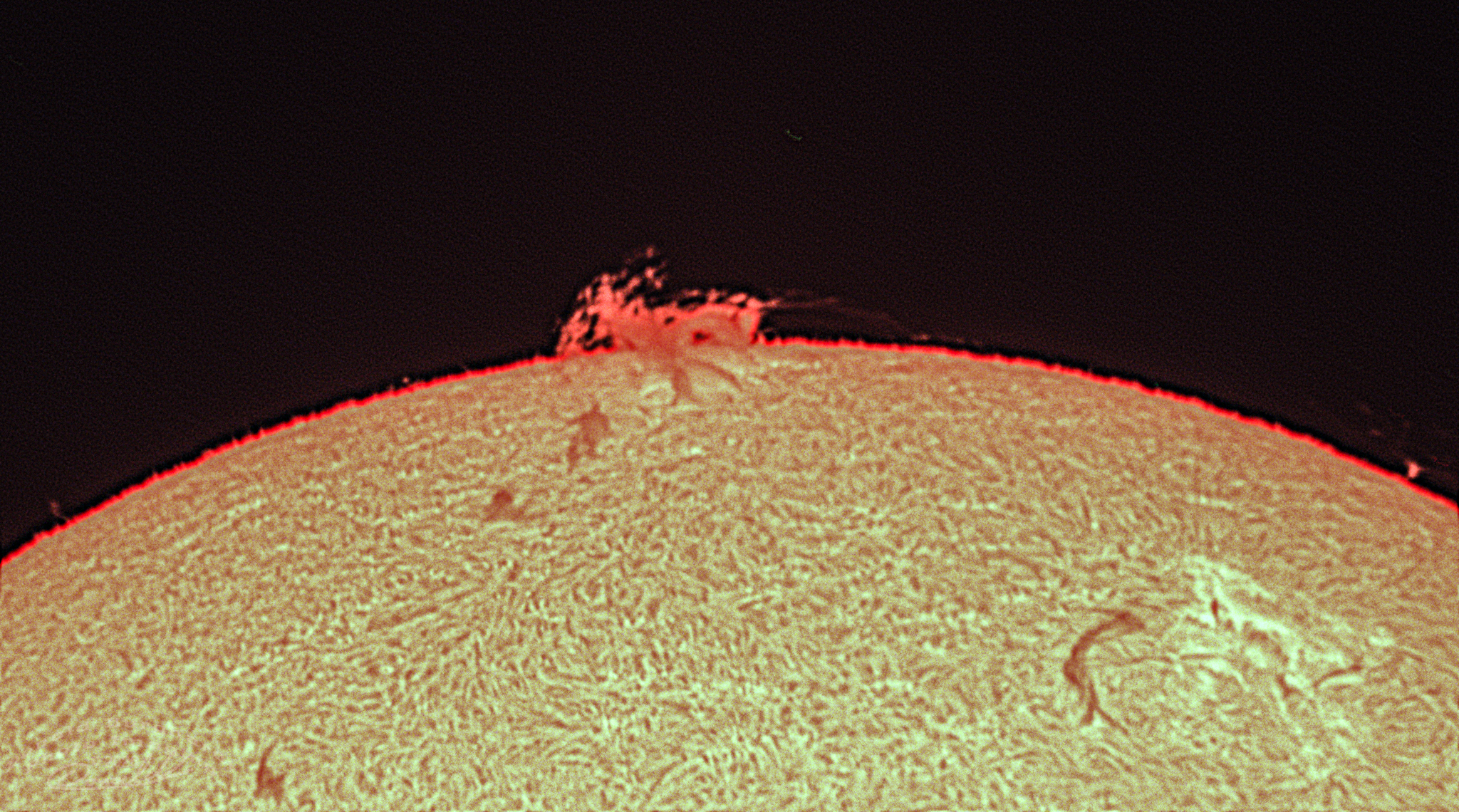
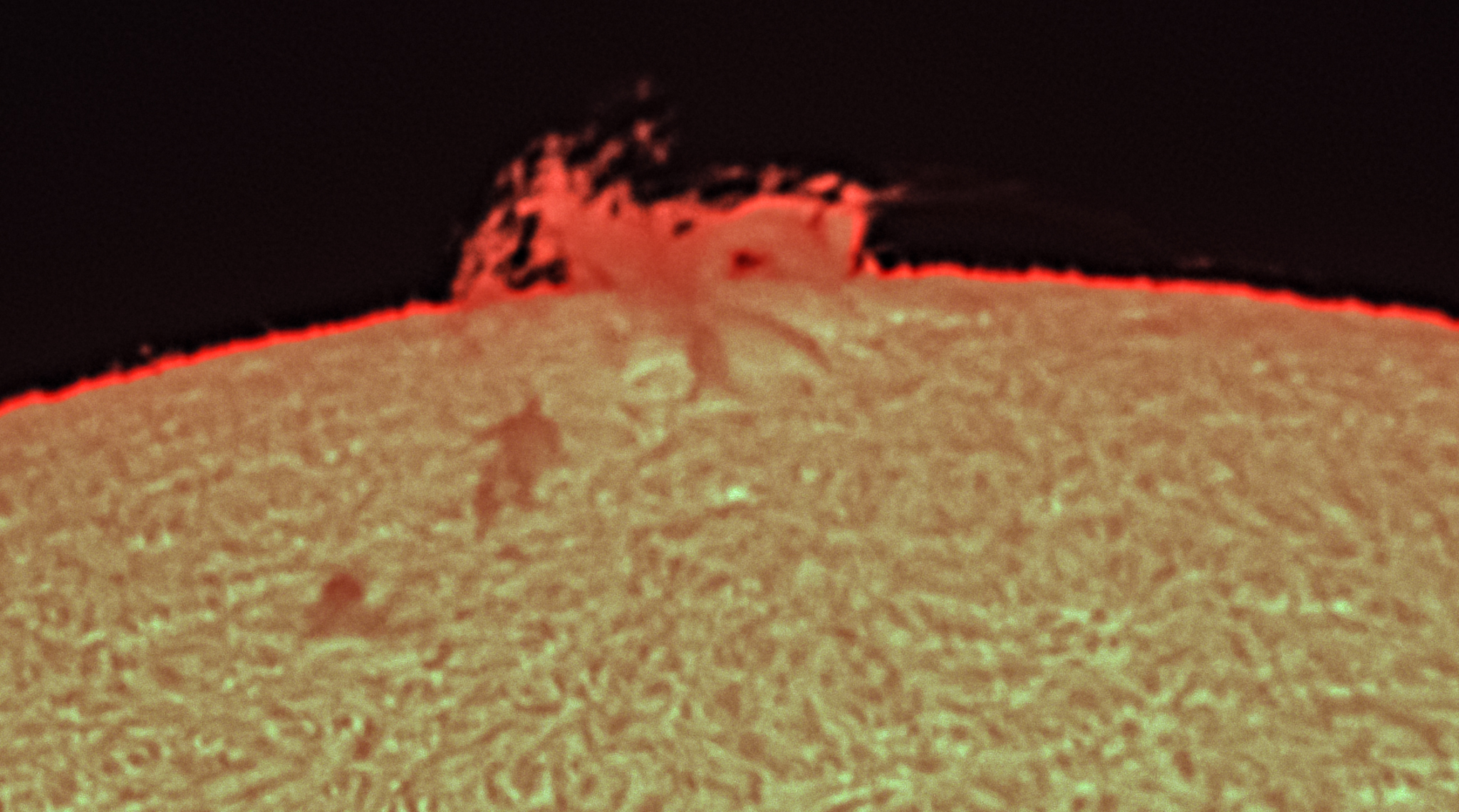
ASI585MC: (first one is full field of view, second is cropped to the field of view of the ASI662MC)
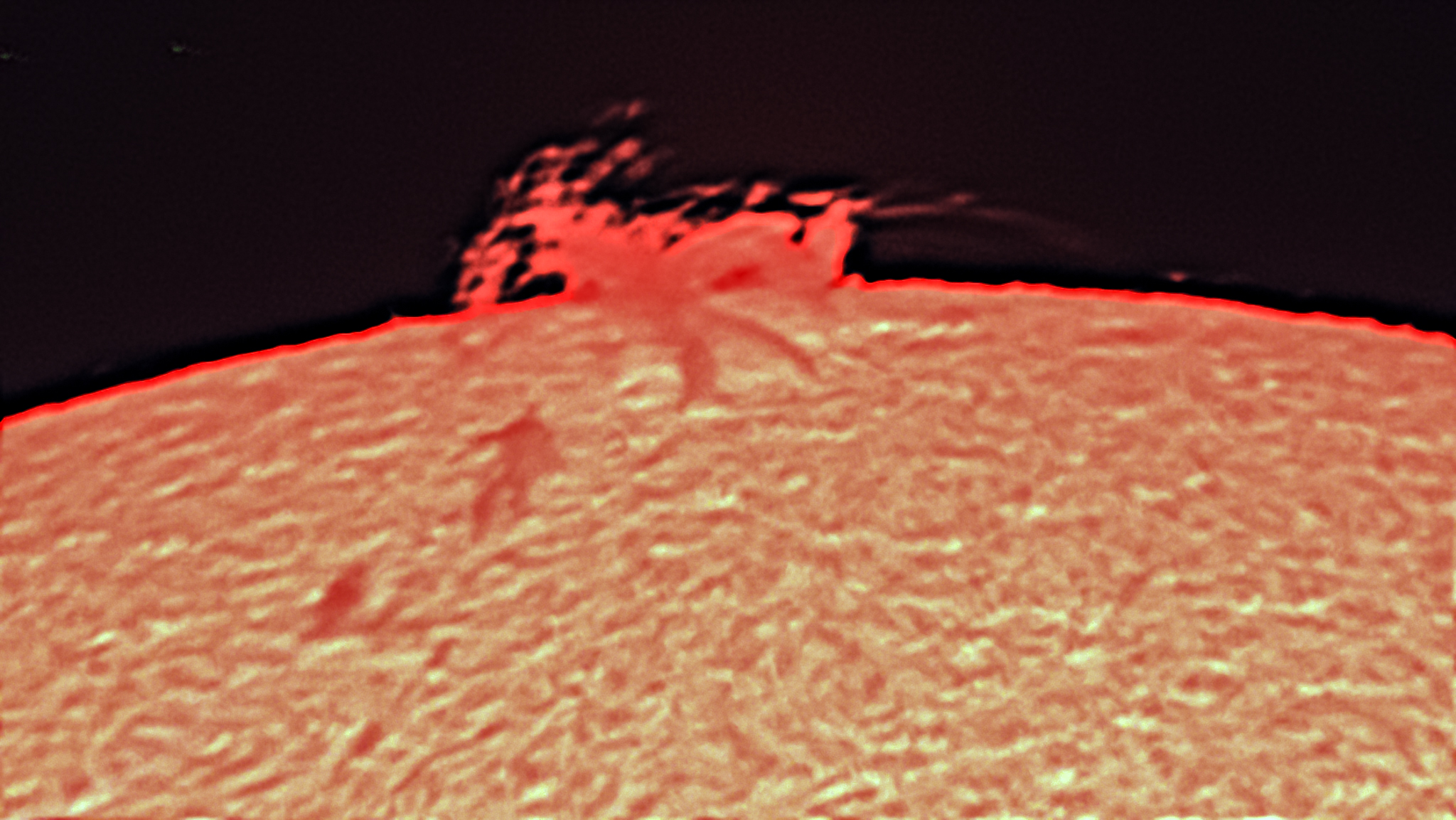
ASI662MC in full field of view:
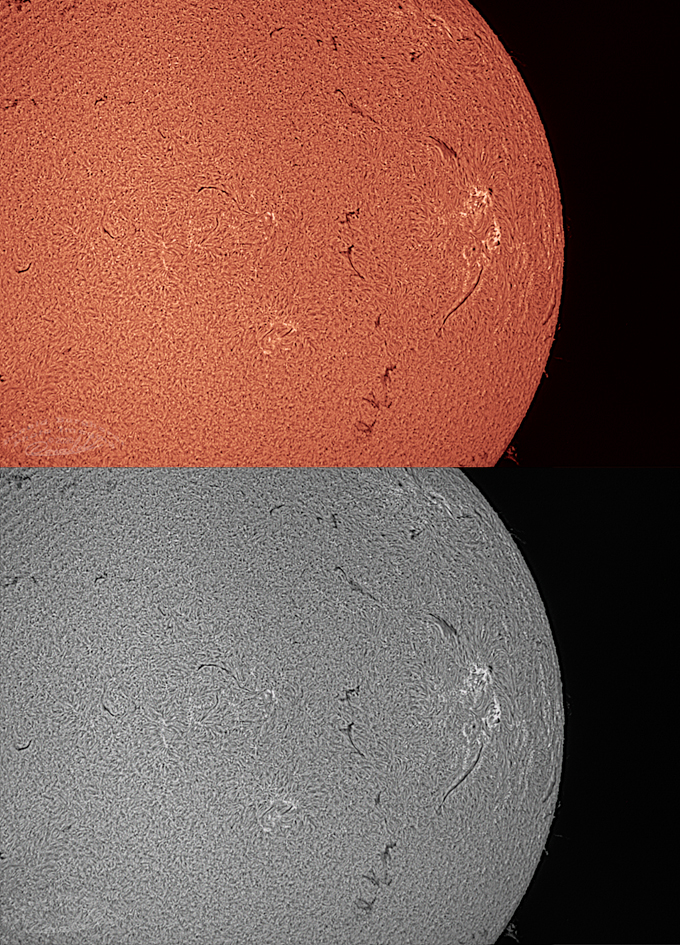
ASI432MM full field of view in free chosen colour and original black and white file. Notice the characteristic Newton rings in the upper left corner. A tilter was used though so they could have been worse.