
Solar Telescope
My solar telescope is the Lunt ST70/420 LS60MT PT B1200Ha OTA Double Stack. That is a mouth full so let's dissect that:
Lunt is the brand, to my modest knowledge the best in its playing field as even NASA uses them.
ST70: Some kind of type of which I could never retrieve what the 70 stands for but I guess it's safe to say that 'ST' means 'Solar Telescope'. The 420 stands for the focal length of 420mm.
LS: Lunt Scope or Lunt Solar, something like that.
60 is the aperture of the telescope.
MT: ModularTelescope. It can be converted into a classic deep sky telescope.
PT: Pressure Tuning. To shift the very fine difference in wavelengths the pressure (density) of the air in between the optical elements of the Etalon can be varied by a compressor.
B1200Ha: the blocking filter for Hydrogen alfa (656.46 nm) with a size of 12mm so photography for this aperture telescope is comfortable.
OTA; Optical Tube Assembly. No mount and/or tripod, just the telescope.
Double Stack: an additional filter to get a boost in contrast and detail. This part takes longer to deliver so I am impatient to finally receive it hopefully in the next 7-10 days.
BE AWARE! The LS40 is not suitable for DSLR cameras! Some may function but the back focus is not designed for them!
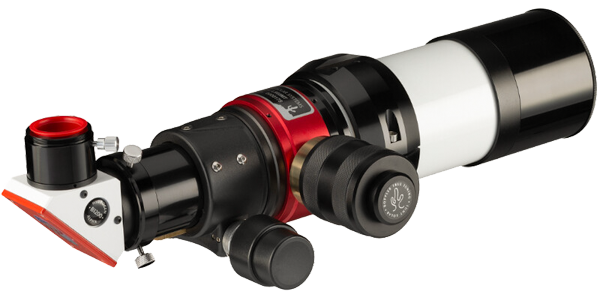
This telescope can be fitted for multiple purposes like:
- Ha for the hot upper part of the chromosphere of the sun. The used wavelength is 656.46nm in vacuum and 656.28 in our atmosphere.
- Ca-K for the cooler lower part of the chromosphere right on top of the photosphere of the sun. The used wavelength is 393.4nm.
- Deep sky for nebulae and galaxies.
- All kinds of Terrestrial purposes.
The following has been composed with the help of Lumo (the AI toolkit from Proton) because of the sheer tsunami of parameters and data to compare. I have selected and reformatted where necessary to compact the text Lumo delivered. Layout and design will be done shortly.
Basic Imaging parameters with the ZWO ASI585MC camera:
Image scale in solar photography with the Lunt LS60MT:
The Sun has a diameter of about 30 arc minutes.
Native without Barlow (420 mm):
- Image scale: (2.9 / 420) × 206,265 ≈ 1.42 arcseconds per pixel
- Field of view:
Horizontal: 3840 × 1.42" ≈ 5453" ≈ 90.9 arc minutes
Vertical: 2160 × 1.42" ≈ 3067" ≈ 51.1 arc minutes
Now the full Sun (30') fits on your sensor with more than enough margin.
Calculations for the ideal Barlow/Powermate:
Scenario A: Without Barlow/PowerMate (Direct Focus)
Focal length: 420mm
Pixel size: 2.9µm (ASI585MC)
Image Scale: $206,265 \times 2.9 / 420 \approx$ 1.42 "/px
Analysis:
Dawes limit (60mm): $116 / 60 \approx$ 1.93 arcseconds
Pixels per resolution element: $1.93 / 1.42 \approx$ 1.36 pixels
Conclusion: Undersampled. You are missing detail.
Scenario B: With Barlow/PowerMate (Magnification)
Pixels per Resolution Element Required Image Scale ("/px) Required Focal Length Required Barlow Factor
2 pixels (Minimum) 0.96" ~660 mm 1.57x
3 pixels (Optimal) 0.64" ~990 mm 2.36x
4 pixels (Conservative) 0.48" ~1310 mm 3.12x
Recommended Optics
Optics Effective Focal Length Image Scale ("/px) Pixels per Resolution Assessment
No Barlow 420mm 1.42" 1.36x ❌ Undersampled
2x Barlow 840mm 0.71" 2.72x ✅ Good
2.5x PowerMate 1050mm 0.57" 3.39x ⭐ Ideal
3x Barlow 1260mm 0.47" 4.11x ✅ Good (but darker)
Conclusion
The 2.5x PowerMate is the best choice for the Lunt LS60MT with the ASI585MC:
Effective focal length: 1050mm
Image Scale: 0.57 "/px
Pixels per resolution element: ~3.4x
This is optimal for solar photography with this combination.
The Lunt LS60MT (Converted to a 420mm Refractor)
Context: If you convert the Lunt LS60MT into a standard refractor by removing the Etalon and blocking filter, you have a 60mm refractor with a 420mm focal length.
With the 5x PowerMate:
Effective focal length: 420 \times 5 = 2100\text{mm}
With ASI585MC (2.9µm pixels):
Image Scale: 206,265 \times 2.9 / 2100 \approx 0.285 "/px.
Pixels per resolution element (Dawes 1.93"): ~6.8 pixels.
Analysis:
This is extreme oversampling, but for a 60mm refractor, this is far more useful than for a 200mm telescope.
Why? A 60mm refractor has a small aperture, meaning the diffraction limit (theoretical resolution) is larger (1.93") than for a large telescope.
In planetary photography with a small telescope, it is often necessary to magnify significantly to fill the sensor properly and utilise the diffraction limit.
Example: If you photograph Jupiter with a 60mm refractor without a Barlow, the image on your sensor is very small. With the 5x PowerMate, the image becomes large enough to capture the finest details (bands, Great Red Spot) sharply, provided the seeing allows it.
Conclusion: Yes, the TeleVue 5x PowerMate is excellently suited for the converted Lunt LS60MT (as a refractor) with the ASI585MC. It is one of the few situations where a 5x factor is truly useful for planetary photography.
Why does this work here?
Small Aperture: A 60mm telescope has a relatively low resolution (1.93"). To sample this resolution adequately on a camera with 2.9µm pixels, you need significant magnification.
Short Focal Length: The original 420mm is too short for the ASI585MC. The 5x PowerMate turns it into a 2100mm telescope, which is the perfect focal length for this camera.
EdgeHD vs. Refractor: The EdgeHD is already a long telescope (2032mm), so extra magnification is less necessary. The Lunt (as a refractor) is short, so extra magnification is essential.
Practical Advice for the Converted Lunt
Setup: Lunt LS60MT (as a refractor) + TeleVue 5x PowerMate + ASI585MC.
Application: Planetary photography (Jupiter, Saturnus, Mars, Venus).
Condition: You need good seeing. In poor seeing (turbulence), the image becomes blurry. However, in good seeing, you can capture the finest details that you would miss with lower magnification.
Exposure: Ensure sufficient exposure. The 5x PowerMate significantly reduces brightness. Use a high gain or longer exposure time (but not so long as to cause motion blur).
Stacking: Use software to stack thousands of frames and select the best images.
Summary
Use a 2x or 2.5x PowerMate for solar on normal days. The 5x only during extremely good seeing.
Converted to 60mm Refractor, 420mm: The 5x PowerMate is perfect. It turns a short telescope into a long, powerful instrument for planetary photography with the ASI585MC.
So yes, you are right: the TeleVue 5x PowerMate is an excellent choice for the converted Lunt LS60MT as a refractor! It is one of the few situations where a 5x factor is truly useful.